
Foam Box vs Digital Scan for Orthotics: Accuracy, Workflow & Clinical Insights
Compare foam box vs digital scan for orthotics. Learn differences in accuracy, workflow, patient outcomes, and why digital scanning is transforming clinical practice.
CLINICAL INSIGHTS
4/18/20264 min read
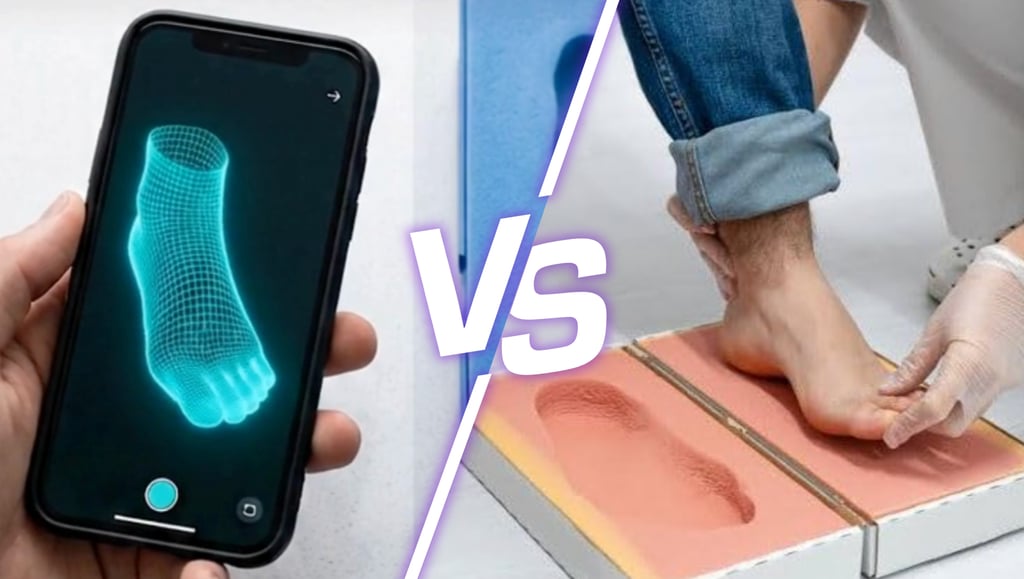
Foam Box vs Digital Scan: what clinicians need to know?
Introduction
For decades, capturing the shape of the foot has been the starting point of orthotic design.
First, it was plaster casting. Then came foam boxes. Today, we’re talking about 3D scanning, CAD design, and fully digital workflows
But here’s the real question clinicians are asking:
Does the method of capture actually change outcomes?
Or is this just a shift in tools, not results? The answer is more nuanced than most people think.
Understanding the two approaches
Before comparing, let’s get clarity:
Foam Box (traditional method)
A foam box works by having the patient step into a soft foam impression tray. The material compresses and captures a negative impression of the plantar surface.
It’s simple. It’s familiar. And it’s still widely used.
Digital Scan (modern method)
A digital scan captures the foot using 3D imaging technology, creating a precise digital model that can be used for CAD-based orthotic design.
This model can be:
Edited
Stored
Reused
Modified without re-casting
And that changes the entire workflow.
What research actually says (not opinions)
Let’s cut through the noise. A recent randomized controlled trial published in clinical research literature compared foam-box casting and direct digital scanning for orthotic insoles.
Here’s what they found:
Both methods improved pain and function significantly
No major difference in clinical outcomes
BUT digital scanning showed:
Higher patient satisfaction
Better adherence
Fewer post-production modifications
Lower overall cost and time burden
That last part is critical. Because in real practice, efficiency matters just as much as outcomes.
Accuracy & Reliability: where things get interesting
Accuracy isn’t as straightforward as “digital is better.” A systematic review comparing 3D scanning with traditional methods found:
3D scanning is generally faster than casting methods
Reliability varies depending on technique and parameters
Foam box impressions showed lower reliability in some measurements
3D scanning often demonstrated excellent repeatability in key dimensions
In simpler terms:
Foam box = dependent on clinician handling
Digital scan = dependent on device quality + protocol
The hidden problem with Foam Boxes
Foam boxes seem simple, but they come with limitations most clinicians don’t talk about openly. When a patient steps into a foam box:
The foot is often already under load
The arch may collapse during capture
Soft tissue displacement can distort true structure
This means you’re not always capturing the ideal corrective position — you’re capturing the foot under pressure. And that matters when designing support.
But Digital Scans aren’t perfect either
Let’s not romanticize technology. Digital scans have their own challenges:
Scanner quality varies significantly
Poor scanning technique leads to inaccurate models
Weight-bearing vs non-weight-bearing position changes results
In fact, studies show variation in scan outputs depending on device and conditions, even when final orthotic designs remain similar
So no.. digital is not “automatically better.” It’s operator + system dependent.
Shape capture differences can affect outcomes
Here’s something most blogs miss. Different methods don’t just capture measurements differently, they capture entire surface geometry differently.
A 2025 study on diabetic patients showed:
Foam box impressions produced larger foot dimensions
3D scans showed variations in arch height and volume
Differences in shape directly impact orthotic design and pressure distribution
This is huge. Because orthotics are not built on numbers alone.. they’re built on surface interaction.
Clinical Workflow: the real differentiator
Let’s step out of theory and into practice.
Physical impression
Shipping / storage
Manual corrections
Limited reproducibility
Foam Box Workflow
Digital Workflow
Instant capture
Direct CAD integration
Easy modifications
Repeatable designs
Remote collaboration
This is where digital clearly wins. Not just in accuracy, but in scalability and consistency.
Where Foam Box still makes sense
Despite all the innovation, foam boxes are not obsolete. They still work well in:
✔ Low-resource settings
✔ Clinics without digital infrastructure
✔ Simple cases requiring basic support
✔ Situations where cost is the primary constraint
They’re not “wrong.” They’re just limited.
Where Digital Scanning outperforms
Digital scanning becomes significantly more valuable when:
✔ Precision matters (diabetic foot, high-risk patients)
✔ Repeatability is required
✔ Clinics handle high patient volumes
✔ Design modifications are frequent
✔ Integration with CAD/CAM systems is needed
This is especially relevant in modern O&P setups.
The bigger shift: from tools to systems
Here’s the real shift happening. Clinicians are no longer choosing between Foam vs scan. They’re choosing between Manual workflow vs digital ecosystem
Because scanning is just the first step. The real value comes from:
Digital design
Simulation
Data-driven correction
Manufacturing precision
That’s where outcomes evolve.
What clinicians should actually focus on?
Instead of asking “Foam box or digital scan?” Ask:
What level of precision does my patient need?
Can I reproduce the same result consistently?
How many adjustments am I making post-delivery?
Is my workflow scalable?
Because ultimately, the goal isn’t capture. It’s clinical outcome + patient satisfaction.
Practical decision guide
Let’s simplify this.
Choose Foam Box if:
You need a low-cost, quick solution
Digital tools are not available
Case complexity is low
Choose Digital Scan if:
You want higher efficiency
You deal with complex conditions
You aim for consistency and scalability
You want fewer remakes and adjustments
The future of orthotic design
We’re moving toward:
AI-assisted modeling
Real-time gait integration
Pressure-based dynamic design
Fully digital patient records
In that world, foam boxes won’t disappear overnight. But they will slowly become a fallback, not the standard.
Conclusion
Foam box and digital scanning both have their place in clinical practice. But they are not equal in what they enable. Foam box captures a shape.
Digital scanning enables a system. And in modern orthotics, systems win.
If you’re looking to move beyond traditional methods, it’s time to explore solutions that are:
✔ Precision-engineered for clinical accuracy
✔ Digitally customized for every patient
✔ Corrective by design for better outcomes
→ Book a demo and experience a smarter, faster, and more reliable way to design orthotics.
Frequently Asked Questions (FAQs)
Is digital scanning more accurate than foam box?
Not always. Accuracy depends on technique and tools, but digital scanning offers better consistency and repeatability.
Why is foam box still used?
It is simple, cost-effective, and requires no advanced technology, making it accessible in many clinical settings.
Does scanning improve patient outcomes?
Clinical outcomes may be similar, but digital methods often improve satisfaction, efficiency, and reduce adjustments.
Which method is better for diabetic patients?
Digital scanning is often preferred due to better pressure mapping and customization capabilities.
BenGait Labs Private Limited
Phone
hello@bengaitlabs.com
+91 9971176444
© 2025. All rights reserved.
Products
Legal
Technology
HO
Regd. Office : B 273, Sector 26, Noida 201301
D192, LGF, Sector 27, Noida 201301