
Why Lightweight Prosthetic Sockets Improve Walking Comfort and Energy Efficiency
Discover how lightweight prosthetic sockets improve walking comfort, reduce fatigue, and enhance energy efficiency. Learn the benefits of MJF PA12 prosthetic sockets and modern digital design workflows.
CUSTOM PROSTHETICS
Dr. Rahul Gupta
5/9/20265 min read
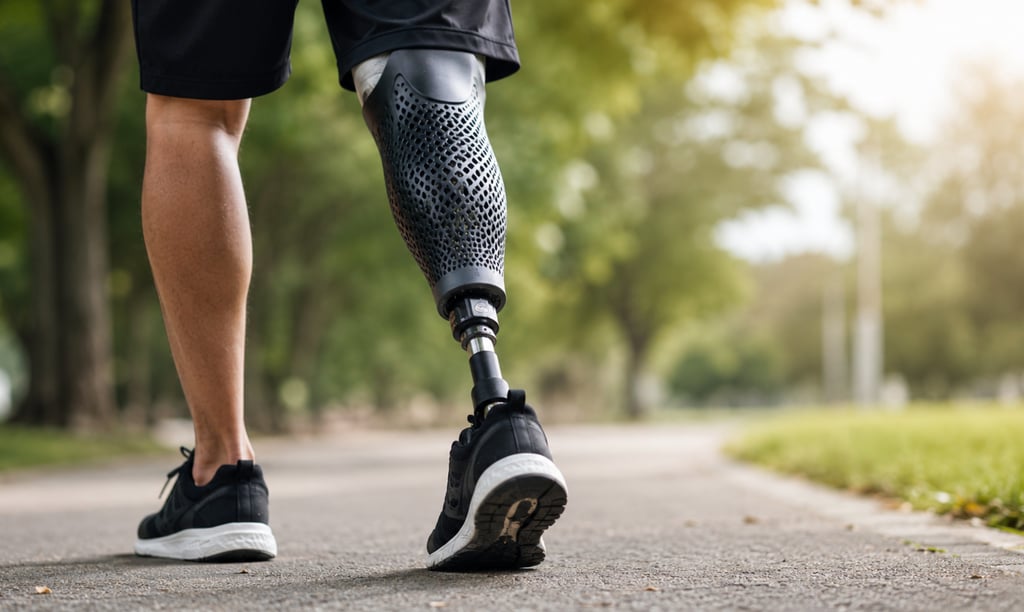
Why lightweight prosthetic sockets improve walking comfort and energy efficiency
Introduction
For prosthetic users, comfort is not just about fit. Weight plays a major role too. Even small differences in socket weight can affect how a person walks, how quickly fatigue builds up, and how comfortable the prosthesis feels throughout the day. This becomes even more important in above-knee prosthetics, where energy demand during walking is already higher. That is why lightweight prosthetic sockets are becoming a major focus in modern prosthetic design. Not simply to reduce weight for the sake of it, but to improve movement, comfort, and long-term usability.
Why socket weight matters more than most people think?
A prosthetic socket is the direct connection between the body and the prosthetic system. If that interface becomes heavy or inefficient, the user feels it during every step.
Over time, excess weight can contribute to:
✔ Faster fatigue during walking
✔ Increased strain on the hip and lower back
✔ Reduced walking confidence
✔ Higher energy expenditure
The effect may not always feel dramatic initially. But across daily movement, the difference becomes noticeable. Especially during prolonged use.
Walking with a prosthesis already requires more energy
Research consistently shows that amputees use more energy while walking compared to non-amputees.
For above-knee amputees, the increase can be significant because the body has to compensate for:
Loss of natural limb mechanics
Reduced muscle contribution
Prosthetic control requirements
When socket weight increases on top of this, the body works even harder. That is why reducing unnecessary weight matters.
Lightweight sockets improve gait efficiency
Walking efficiency is closely linked to how naturally the body can move. Heavy sockets can interfere with this by increasing swing effort during gait.
A lightweight prosthetic socket helps by:
✔ Reducing resistance during leg movement
✔ Improving swing phase control
✔ Making gait feel smoother and less demanding
Even a moderate reduction in weight can positively influence walking comfort over longer durations.
Fatigue reduction changes daily life
One of the most overlooked aspects of prosthetic design is fatigue. Many users can technically walk well in short sessions.
But the real challenge begins after hours of movement. That is where socket weight becomes important.
Users with lighter prosthetic systems often report:
Less exhaustion by the end of the day
Better tolerance for extended walking
Improved confidence during daily activities
This directly affects independence and quality of life.
Why material choice matters?
Not all prosthetic sockets behave the same way. Traditional fabrication methods can sometimes create sockets that are heavier than necessary or inconsistent in thickness. Modern digital workflows are changing this.
Using advanced materials like MJF PA12 allows clinicians and designers to create sockets that are:
✔ Strong yet lightweight
✔ Structurally consistent
✔ More precise in geometry
What is MJF PA12 and why is it important?
MJF PA12 refers to Multi Jet Fusion Nylon PA12, a high-performance material widely used in advanced 3D printing.
In prosthetics, it offers several advantages.
1-Strength without unnecessary bulk
The material provides excellent durability while keeping weight lower than many traditional fabrication approaches.
2-Better consistency during fabrication
Because the socket is digitally manufactured, thickness and geometry remain more controlled. This helps improve predictability in fit and performance.
3-Improved surface quality
Smooth and uniform surfaces contribute to better comfort and reduced irritation.
A common misconception is that lighter sockets are less durable. That is not necessarily true.
When designed properly, lightweight sockets can still provide:
✔ Structural strength
✔ Stability during weight bearing
✔ Reliable long-term performance
The key lies in how geometry, thickness, and reinforcement are managed during design.
The benefits of lightweight sockets become more noticeable in everyday situations.
For example:
Walking for longer periods.
Climbing stairs.
Standing for extended durations.
Daily commuting.
Small reductions in fatigue often lead to significant improvements in overall usability. Users frequently describe the prosthesis as feeling more natural and less physically demanding.
Lightweight does not mean weak
Comfort improvements in real-world use
Digital design improves weight optimization
Traditional prosthetic workflows often depend heavily on manual fabrication techniques, where the final outcome can vary based on experience, hand skills, and repeated adjustments during production. While this approach has supported prosthetic care for years, achieving precise weight optimization through fully manual methods can be challenging. Small variations in material distribution or wall thickness may affect both comfort and overall socket performance.
Modern digital socket design workflows are helping clinicians and fabrication teams move toward a more controlled and consistent process. With digital design tools, it becomes easier to fine-tune socket structure with greater accuracy and repeatability. This allows:
✔ Better control over wall thickness
✔ Region-specific reinforcement where additional strength is needed
✔ More consistent fabrication outcomes across different cases
As a result, weight reduction becomes a more intentional and measurable part of the design process helping create lighter sockets without compromising structural integrity, stability, or patient confidence during daily use.
Energy efficiency is not just a technical metric. It affects how long a person can comfortably use their prosthesis each day.
When walking becomes less physically demanding- mobility improves, daily activity levels increase and confidence grows..
This is especially important for active prosthetic users trying to return to work, travel, or independent living.
Why energy efficiency matters in prosthetics?
The future of prosthetic socket design
There is a clear shift happening in prosthetics. The focus is moving beyond simply creating functional devices.
Now the emphasis is on:
Better biomechanical performance
Improved patient comfort
More efficient movement
Lightweight digitally designed sockets are becoming an important part of that transition.
Not because they look advanced but because they improve real-world outcomes.
Conclusion
Socket design is not just about achieving the right fit, it’s about how the prosthesis feels after hours of walking, standing, and real everyday use. Even small reductions in unnecessary weight can make a noticeable difference in a user’s comfort, movement, and overall experience throughout the day. A lighter socket can help reduce fatigue, improve walking efficiency, and make daily activities feel less physically demanding.
For many prosthetic users, comfort is closely connected to confidence. When a prosthesis feels balanced, supportive, and less heavy during prolonged use, it can positively impact mobility, consistency of wear, and trust in the device itself.
With advanced materials like MJF PA12 and more controlled digital workflows, modern prosthetic socket design is becoming more precise and predictable. These technologies are helping create lighter, more refined sockets while still maintaining the strength and durability needed for long-term use ultimately supporting more comfortable and reliable outcomes for prosthetic users.
If you are exploring more comfortable and energy-efficient prosthetic solutions:
Frequently Asked Questions (FAQs)
Why are lightweight prosthetic sockets better?
They reduce fatigue, improve walking comfort, and make movement feel more natural.
What is MJF PA12 in prosthetics?
MJF PA12 is a durable lightweight nylon material used in advanced 3D printed prosthetic sockets.
Can lightweight sockets improve walking efficiency?
Yes, reducing socket weight can lower energy expenditure and improve gait efficiency.
Are lightweight prosthetic sockets durable?
When properly designed, they provide excellent strength and long-term reliability.
How does digital design help reduce prosthetic weight?
Digital workflows allow precise control over thickness and reinforcement, helping optimize weight without compromising stability.
BenGait Labs Private Limited
Phone
hello@bengaitlabs.com
+91 9971176444
© 2025. All rights reserved.
Products
Legal
Technology
HO
Regd. Office : B 273, Sector 26, Noida 201301
D192, LGF, Sector 27, Noida 201301