
Why socket fit is the most critical factor in prosthetics for comfort, control and long term outcomes?
Learn why socket fit is the most critical factor in prosthetics. Explore how proper fit impacts comfort, mobility, and long term outcomes, and how modern design approaches improve consistency.
CUSTOM PROSTHETICS
4/28/20263 min read
Why socket fit is the most critical factor in prosthetics?
Introduction
When people think about prosthetics, they often focus on advanced components, materials, or technology. But ask any experienced clinician, and the answer is almost always the same. Nothing matters more than the socket fit.
The socket is not just another component. It is the direct interface between the human body and the prosthetic system.
If that interface is not right, everything else: alignment, mobility, comfort.. starts to break down.

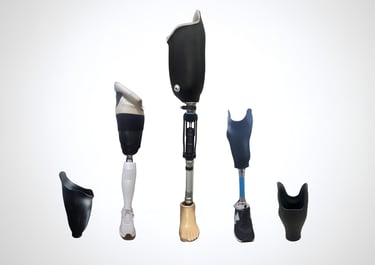
A prosthetic limb can have the best components available. But without a well-fitting socket, performance drops significantly. The reason is simple.
The socket is responsible for:
Transferring load safely to the limb
Maintaining stability during movement
Allowing controlled motion and balance
When this connection is compromised, even the most advanced prosthetic systems fail to deliver expected outcomes.
The socket is where everything begins
Poor socket fit is the leading cause of dissatisfaction
Research consistently shows that socket fit is the most important factor influencing prosthetic success and user satisfaction.
In fact, a large percentage of amputees report socket fit issues as their biggest challenge. Many prosthesis adjustments are driven by fit-related problems. Poor fit is a major reason for prosthesis rejection.
That tells you everything. It is not a minor issue. It is the core issue.
What happens when socket fit is not correct?
A poor fit does not just cause discomfort. It creates a chain reaction.
Here’s what typically happens:
✔ Uneven pressure distribution
✔ Skin irritation or breakdown
✔ Instability while walking
✔ Increased energy expenditure
✔ Reduced confidence in movement
Over time, this affects not just mobility but overall quality of life.
Good socket fit is more than just comfort
Many people assume socket fit is only about comfort. That is only part of the story.
A well-designed socket ensures:
✔ Proper load transfer across pressure-tolerant areas
✔ Reduced stress on sensitive regions
✔ Better control during gait
✔ Improved alignment and posture
This directly impacts how naturally a person can walk and function.
Why achieving the right fit is so challenging?
If socket fit is so important, why is it still a challenge?
Because it is not a static problem. The residual limb changes constantly: volume fluctuations throughout the day, soft tissue movement, changes due to activity level or health conditions.
This makes socket fitting a dynamic process, not a one-time solution.
The role of clinical expertise in socket design
Socket design is not purely technical. It is deeply clinical.
Each adjustment made during rectification reflects:
Pressure tolerance of tissues
Anatomical variations
Patient-specific needs
Much of this knowledge comes from experience, not just data. That is why tools should support clinicians, not override them.
Where traditional workflows fall short
Conventional socket design often involves: multiple iterations, trial and error adjustments and time-consuming refinements.
This can lead to delays and inconsistent results.
Even digital tools, if not designed correctly, can introduce:
Loss of clinical nuance
Over-reliance on presets
Reduced control during modification
Moving toward more predictable socket outcomes
There is a clear shift happening in prosthetic design. The focus is moving from iteration to predictability.
Modern approaches aim to:
✔ Improve scan quality and input consistency
✔ Provide better visualization for alignment
✔ Enable precise and localized rectification
✔ Reduce rework through controlled design steps
This is where platforms like BenX are evolving the workflow — by improving clarity and control without limiting clinical decision-making.
Why digital design must remain clinically driven?
Technology has an important role to play. But it should not replace clinical judgment. Instead, it should: enhance visibility, improve repeatability and reduce manual corrections.
The goal is not automation for the sake of speed. The goal is better outcomes through better control.
The impact of better socket fit on patient outcomes
When socket fit is done right, the difference is significant.
Patients experience:
✔ Greater comfort throughout the day
✔ Improved walking efficiency
✔ Higher confidence in mobility
✔ Better long term prosthesis usage
And most importantly, a better quality of life.
From trial and error to clinical precision
Final thoughts
At its core, prosthetic success depends on one thing. How well the socket fits. Everything else builds on top of that.
As technology evolves, the focus should remain clear: Not more automation. Not more complexity.
But better alignment between clinical intent and final outcome.
Optimal comfort begins with a precision fit. Book an expert assessment with our specialist team today!
Traditionally, socket design has relied on repeated adjustments. But with improved workflows, this is changing.
The shift is toward: fewer iterations, more predictable outcomes and greater consistency across cases.
This is not about removing the clinician from the process. It is about giving them better tools to apply their expertise.
Frequently Asked Questions (FAQs)
Why is socket fit important in prosthetics?
What happens if a prosthetic socket does not fit properly?
How do clinicians ensure proper socket fit?
Can digital tools improve socket fit?
How often does a prosthetic socket need adjustment?
Adjustments are often required over time due to changes in limb volume and activity levels.
Socket fit is important because it directly affects comfort, stability, and control of the prosthetic limb.
It can cause pain, skin issues, instability, and reduced mobility.
Through detailed assessment, precise modifications, and continuous adjustments based on patient feedback.
Yes, when designed correctly, they can improve accuracy, consistency, and reduce rework.
BenGait Labs Private Limited
Phone
hello@bengaitlabs.com
+91 9971176444
© 2025. All rights reserved.
Products
Legal
Technology
HO
Regd. Office : B 273, Sector 26, Noida 201301
D192, LGF, Sector 27, Noida 201301