
What Makes a Good Below Knee Prosthetic Socket? Fit, Comfort and Suspension Explained
Learn what makes a good below knee prosthetic socket, including pressure distribution, suspension, trimline design, and why socket fit matters more than expensive prosthetic components.
CUSTOM PROSTHETICS
5/14/20266 min read
What makes a good below knee prosthetic socket? A clinical perspective
Introduction
When people think about prosthetics, they often focus on advanced feet, high-end knees, or expensive component systems.
But clinically, one thing affects comfort and mobility more than almost anything else.
The socket.
A prosthetic socket is not just the part that connects the residual limb to the prosthesis. It is the entire interface between the human body and the mechanical system. Every movement, every step, and every shift in balance passes through it. That is why even a highly advanced prosthetic setup can feel uncomfortable if the prosthetic socket fit is poor. And on the other hand, a well-designed below knee prosthetic socket can dramatically improve walking comfort, stability, and confidence even without the most expensive components.
In below knee prosthetics especially, socket fit often becomes the defining factor in long-term success.
Why socket fit matters so much?
The residual limb is sensitive, dynamic, and constantly interacting with the prosthesis during movement.
A good socket has to manage multiple things at the same time:
Stability during stance
Controlled pressure distribution
Suspension during swing phase
Comfort during prolonged wear
Protection of sensitive anatomical regions
That balance is difficult to achieve. A socket that feels stable but creates pressure pain is not successful. A socket that feels soft but allows movement inside the interface also creates problems over time. Good socket design sits between those extremes.
Pressure distribution is the foundation of comfort
One of the biggest misconceptions people have is assuming that socket comfort simply comes from padding or softness.
In reality, comfort depends much more on how pressure distribution is managed across the residual limb. Certain anatomical areas are naturally more load tolerant, while others are highly pressure sensitive.
A clinically designed socket understands this difference.
Regions like the patellar tendon or medial tibial flare can usually tolerate controlled loading more effectively. Meanwhile, structures such as the fibular head, distal tibia, and tibial crest require careful relief. When pressure distribution is poorly managed, patients often experience discomfort that gradually worsens throughout the day. Sometimes it starts as irritation. Then it becomes instability, fatigue, or even skin breakdown.
This is why clinicians spend significant time refining socket geometry rather than simply tightening the fit.
A good socket should feel secure, not restrictive
Many first-time prosthetic users believe that tighter automatically means better. But excessive compression creates its own problems.
A properly fitted custom prosthetic socket should feel stable without aggressively squeezing the limb. The goal is controlled contact, not forceful containment.
When sockets become overly restrictive, users may experience:
Circulation discomfort
Excessive sweating
Pressure concentration
Difficulty tolerating long hours of wear
On the other hand, loose sockets create pistoning and instability during gait.
The best socket designs achieve stability while still allowing natural limb interaction during movement. That is where clinical expertise matters more than presets or automated shaping tools.
Trimline design affects movement more than most people realize
Trimlines are often overlooked outside clinical discussions. But they directly influence how the prosthesis behaves during real-world activities.
If trimlines are too high, they may restrict knee movement or create discomfort while sitting. If they are too low, stability and suspension can become compromised.
A well-designed trimline should support the limb without interfering with movement patterns. This becomes especially important for active users who spend long hours walking, climbing stairs, or transitioning between standing and sitting throughout the day.
Good trimline design usually goes unnoticed by the user. Bad trimline design becomes noticeable almost immediately.
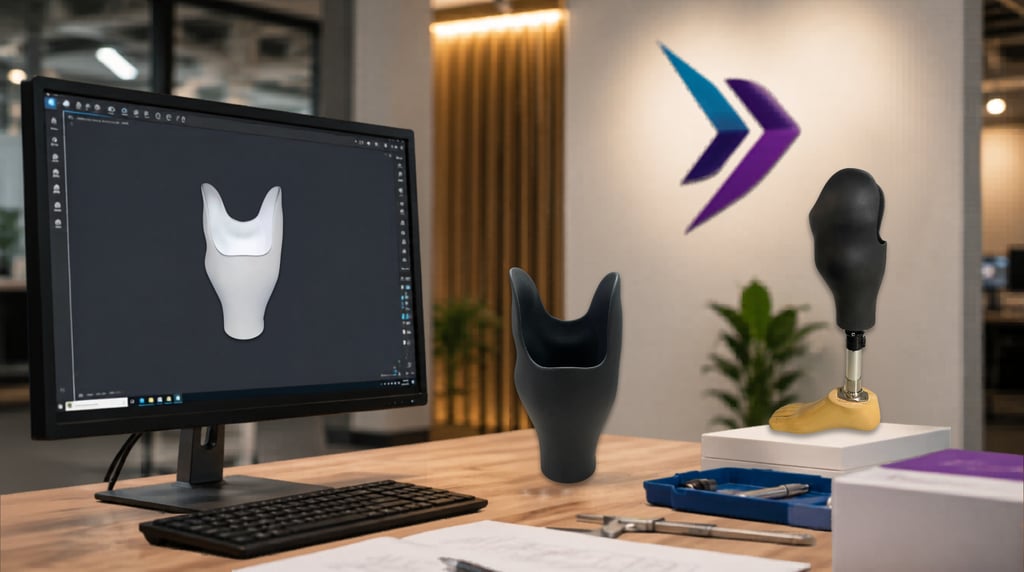
Suspension determines how connected the prosthesis feels
Suspension is the system responsible for keeping the prosthesis securely attached to the limb. Without proper suspension, even a well-shaped socket can feel unstable.
Users often describe poor suspension as:
The prosthesis “pulling away” during walking
Rotational movement inside the socket
Reduced trust during movement
Different prosthetic suspension systems work for different patients. Some benefit from suction systems. Others perform better with pin-lock systems or sleeve suspension depending on limb shape, activity level, and tissue condition.
There is no universally perfect suspension method. The right choice depends on the individual.
Comfort zones and relief areas must be intentional
One of the most important parts of socket design is understanding where pressure should exist and where it should not. Good sockets are not uniformly tight.
Instead, they create intentional zones. Some regions stabilize the limb through controlled loading. Others are relieved to protect sensitive anatomy. When these transitions are abrupt or poorly shaped, users often describe the socket as harsh or unpredictable.
Smooth anatomical transitions matter because the body notices even subtle inconsistencies during repeated walking cycles. This is one reason digital prosthetic design is becoming more important in modern prosthetics. Not because it replaces clinical judgment. But because it helps clinicians apply that judgment more consistently.
Why expensive components cannot compensate for poor socket fit?
This is one of the most important realities in prosthetics. People often assume that upgrading feet or using premium prosthetic components will automatically improve walking comfort. But the socket controls how force enters the prosthetic system. If the interface itself is unstable or uncomfortable, the benefits of advanced components become limited.
A poorly fitting socket can make even premium prosthetic systems feel difficult to use.
Meanwhile, a well-designed socket often improves comfort and confidence more dramatically than changing expensive hardware.
Socket refinement is usually prioritized before component upgrades. Experienced prosthetists understand this early.
That is why socket fit remains one of the most important aspects of long-term prosthetic success.
Digital workflows are improving socket consistency
Traditional fabrication methods rely heavily on manual modification and plaster-based techniques. While skilled clinicians can achieve excellent outcomes through these methods, consistency can still vary.
Modern digital workflows are helping reduce some of that variability. Through structured scanning, controlled rectification, and digitally guided modifications, clinicians can better preserve anatomical intent throughout the process.
This becomes especially valuable in areas like:
Pressure-sensitive modifications
Trimline consistency
Surface smoothing
Suspension integration
The goal is not to remove the clinician from the process but to improve clarity, control, and repeatability.
The socket should reflect clinical thinking, not software presets
One of the challenges in some digital prosthetic workflows is over-automation. Preset-driven modifications may appear efficient, but they can dilute important clinical decisions. Every residual limb behaves differently. Soft tissue condition, muscle activity, bone prominence, and gait behavior all influence how a socket should be shaped.
That is why clinicians still need detailed control over:
Rectification
Relief application
Pressure loading
Alignment
Suspension positioning
Technology which supports clinical expertise, not overrides it. This is where more flexible digital design systems are becoming increasingly important in O&P workflows.
What patients usually notice first?
Clinicians often focus on alignment, biomechanics, and pressure maps. Patients usually notice something simpler first. “How does it feel after several hours?” That question often reveals more than short-term walking assessments. A socket may initially feel acceptable during fitting. But over time, poor pressure distribution or instability becomes obvious.
When socket fit is correct, users often report:
✔ Less fatigue during walking
✔ Better confidence outdoors
✔ Reduced skin irritation
✔ Improved daily tolerance
Those outcomes matter more than impressive specifications on paper.
Conclusion
A great below-knee socket isn't about how "clean" or "high-tech" it looks on the shelf.
It’s about what happens three hours into a busy day, how it handles the constant shift of weight, the way it grips without pinching, and how it manages pressure when life actually gets moving.
The best sockets aren’t created by pushing a button or following a standard template. They’re born from a clinical partnership, one where design is built around how a person actually moves, not just a static scan of their limb.
The goal is simple: No more "good enough" fits. No more over-compressing tissue just to get stability. And definitely no more letting software make the final call over a clinician's intuition.
Because at the end of the day, the socket isn't just another part of the leg. It’s the foundation. When we get that right, we don’t just reduce the need for constant adjustments, we give someone their day back.
→ Explore our BenX O&P design platform
→ Learn more about our custom prosthetic solutions
→ Want to discuss a case or workflow? Connect with our team
Frequently Asked Questions (FAQs)
Why is socket fit important in below knee prosthetics?
Socket fit directly affects comfort, stability, gait efficiency, and skin health.
What causes discomfort inside a prosthetic socket?
Uneven pressure distribution, poor suspension, excessive movement, and incorrect relief areas are common causes.
Why are relief areas important in prosthetic sockets?
They protect sensitive anatomical structures from excessive pressure and irritation.
Can digital workflows improve prosthetic socket design?
Yes, digital workflows improve consistency, pressure management, and anatomical accuracy during design and fabrication.
Does a more expensive prosthetic foot improve comfort automatically?
No. Poor socket fit can limit the effectiveness of even advanced prosthetic components.
BenGait Labs Private Limited
Phone
hello@bengaitlabs.com
+91 9971176444
© 2025. All rights reserved.
Products
Legal
Technology
HO
Regd. Office : B 273, Sector 26, Noida 201301
D192, LGF, Sector 27, Noida 201301