
Top 5 Prosthetic Socket Design Challenges & Solutions
Discover the top 5 prosthetic socket design challenges faced by prosthetists and how clinically controlled digital workflows improve fit, consistency, and patient outcomes.
DIGITAL WORKFLOW
7/23/20267 min read
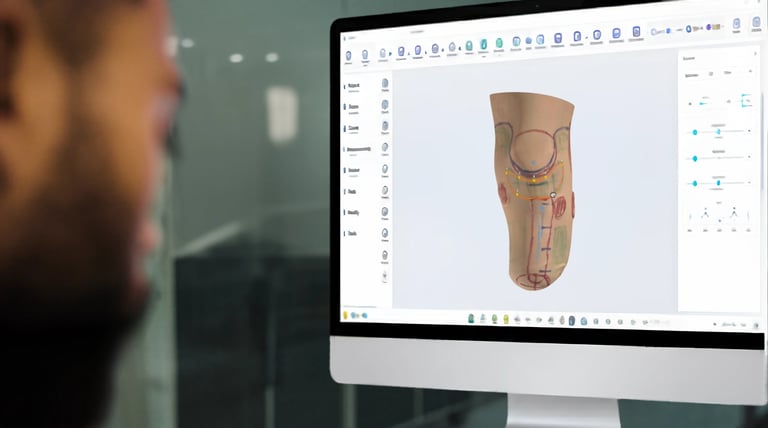
Top 5 challenges every prosthetist faces during socket design (and how digital workflows are solving them)
Every successful prosthetic socket begins long before fabrication
If you ask any professional prosthetist what makes or breaks a prosthesis, the foot, knee, or pricey parts are probably not the response. It's going to be the socket.
The comfort with which stresses are distributed, the stability of the limb, the amount of energy expended by the patient when walking, and ultimately whether the patient wears the prosthesis with confidence every day or avoids it completely are all determined by a well-designed socket. However, one of the most difficult aspects of prosthetic practice is still socket design.
Soft tissue reacts differently in each patient, and each residual limb is distinct. The volume varies. While weight-bearing areas require proper load distribution, bony prominences necessitate cautious alleviation. Additionally, prosthetists frequently work under strict clinical timetables where any change could have an impact on the outcome.
Experience, observation, and repeated modifications have long been key components of traditional handicraft. Software should never take the place of clinical judgement, even though digital technology have revolutionised many parts of prostheses. It ought to make it stronger.
That is why modern O&P design platforms are increasingly shifting away from rigid presets and toward clinician-controlled digital workflows allowing prosthetists to translate their assessment into geometry without compromising their intent.
In this article, we'll explore the five biggest challenges prosthetists face during socket design and how advances in digital workflows are helping improve consistency, efficiency, and patient outcomes.
1) Every residual limb tells a different story
The biggest misconception about socket design is that it's simply about creating a shape that fits. In reality, two patients with the same level of amputation can require completely different socket designs.
Residual limb anatomy varies in countless ways:
✔ Bone prominence
✔ Muscle coverage
✔ Scar tissue
✔ Sensitive areas
✔ Skin quality
✔ Limb volume
✔ Activity level
A socket that performs exceptionally well for one patient may cause discomfort or instability for another and this is where clinical expertise becomes irreplaceable.
An experienced prosthetist doesn't just look at a scan. They interpret years of assessment, palpation, patient feedback, gait observation, and rehabilitation goals before deciding where to apply pressure, where to provide relief, and how the socket should ultimately behave.
Unfortunately, many digital systems still rely on standardized workflows or predefined templates that may not fully capture these individual clinical decisions. Instead of adapting the clinician's thinking, the clinician often ends up adapting to the software.
Modern digital workflows are moving in a different direction giving prosthetists greater control over every stage of the design process while preserving the anatomical details that matter most. Rather than replacing experience, technology should allow clinicians to apply it more precisely and more consistently.
2) Translating clinical assessment into digital geometry
Every prosthetist understands what they want to achieve clinically, it is the challenge is translating that understanding into an accurate digital model.
Consider the decisions made during a typical socket design:
Where should pressure be increased?
Which anatomical landmarks require relief?
How much reduction is appropriate?
How should trimlines follow limb anatomy?
Which regions require reinforcement?
These decisions depend on experience, patient assessment, and clinical reasoning.
Modifications to traditional CAD workflows often feel detached from their original aim, which is one of the issues that physicians frequently experience. Delays in visual feedback make it challenging to confidently forecast the final shape, and minor alterations can necessitate several corrective steps. The design approach consequently becomes more iterative. Clinicians waste considerable effort fixing a socket rather than enhancing it.
By making changes more user-friendly, responsive, and visually predictable, today's clinician-focused digital processes seek to close that gap. Prosthetists may understand how changes affect the model instantly thanks to real-time feedback, which helps preserve anatomical continuity and minimise needless revisions.
The objective is to give clinicians better digital tools to express their expertise.
3) Managing scan quality before design even begins
One of the most neglected problems in prosthetic socket design really starts at the scanning stage rather than during design.
The finished socket can only be as accurate as the data used to make it, regardless of the clinician's level of ability.
Scans are rarely flawless in routine clinical practice. Certain anatomical regions may not be fully caught, patients may move slightly during scanning, and soft tissue may distort under pressure. The end product is a digital model that needs to be thoroughly cleaned up before any substantial design work can start. Prosthetists frequently spend important time fixing holes, eliminating scan noise, adjusting orientation, or reconstructing missing geometry rather than concentrating on clinical decision-making.
These monotonous chores merely postpone patient care rather than enhance it. Software that accepts real-world scan data instead of expecting flawless scans every time is becoming more and more necessary as digital processes proliferate.
Clinicians can concentrate on creating a pleasant and useful socket by starting with clean, anatomically reliable geometry with the aid of an efficient digital process. Technology should streamline the process from scan to socket while maintaining all clinically significant anatomical landmarks, rather than requiring physicians to circumvent software constraints.
4) Achieving consistency without losing clinical individuality
Through years of patient care, each prosthetist develops their own methods. Because no two therapists think exactly similar, those unique approaches are valuable. It can be quite challenging to maintain the same degree of consistency for every patient, every day changes in residual limb volume.
Feedback from patients changes. There is an increase in time constraints.
Modifications may be interpreted differently by different technicians. Depending on their workload or level of weariness, even the same physician may make significantly different design choices. One of the main causes of socket design sometimes becoming an iterative process requiring numerous fitting appointments is this unpredictability.
The goal of digital technology shouldn't be to make every socket identical but to make clinical decisions more repeatable.
When clinicians have greater control over rectification, blocking, anatomical carving, trimlines, thickness, flare design, and alignment while receiving immediate visual feedback then they are better positioned to reproduce successful outcomes consistently.
That consistency benefits everyone. Patients receive a more predictable fit. Clinicians spend less time making unnecessary corrections. Clinics improve efficiency without sacrificing quality. Digital workflows should preserve individuality while improving repeatability.
5) Balancing efficiency with clinical precision
Clinicians are expected to visit more patients, shorten turnaround times, document everything digitally, and still provide highly individualised care as the healthcare industry changes quickly. These demands frequently lead to a challenging compromise, hasten the process, and cause crucial clinical facts to be missed. Workflow efficiency decreases if you spend too much time perfecting each change. The most skilled prosthetists know that accuracy should never be sacrificed for speed.
Fortunately, that compromise is starting to disappear thanks to modern digital technologies.
Prosthetists can spend more time using their skills and less time fixing software bugs thanks to real-time modelling, clinician-controlled modifications, intelligent geometry handling, and digital files that are ready for fabrication.
Modern digital design should complement craftsmanship rather than replace it. Clinicians have more time to concentrate on patient assessment, communication, and getting the ideal socket fit when repetitive tasks are minimised.
In the end, technology is most useful when it enables clinicians to make clinical decisions more effectively and confidently, rather than when it makes clinical decisions itself.
Clinical expertise should always remain in control
One idea should never change as digital technologies advance.. clinical skill should be supplemented by software rather than replaced.
Careful patient evaluation, anatomical knowledge, and years of clinical experience form the foundation of any effective prosthetic socket. "What digital technology does is simply make it easier to translate that expertise into predictable, accurate design."
BenX's development at BenGait Labs has been guided by this idea.
BenX was created with a clinician-first workflow in mind, giving prosthetists more control over scan processing, alignment, rectification, blocking, anatomical carving, elongation, reduction, flare design, variable thickness, locking integration, and fabrication-ready geometry rather than depending on strict presets or automated shortcuts.
The objective is straightforward: reduce unnecessary iteration while preserving complete clinical control.
Final thoughts
It has never been easy to design a prosthetic socket that is sturdy, comfortable, and long-lasting. Every treatment decision affects the final result, and every patient has distinct anatomical and functional obstacles. Prosthetists won't be replaced by technology in socket design, even though digital workflows are still revolutionising the field.
It's about providing prosthetists with improved equipment so they can continue to provide the quality of care they already aim for on a daily basis.
The emphasis should stay precisely where it belongs as digital platforms develop further enhancing clinical knowledge, enhancing uniformity and improving the results for patients. In this way, contemporary prosthetic design progresses from iteration to intention.
Whether you're an independent prosthetist, rehabilitation centre, hospital, or O&P clinic, the right design platform should adapt to your clinical expertise, not the other way around.
Book a personalised BenX demonstration and explore the future of digitally customized prosthetic design.
FAQs
Why is prosthetic socket design considered the most important part of a prosthesis?
The socket is the interface between the patient's residual limb and the prosthesis. A well-designed socket improves comfort, stability, pressure distribution, and walking efficiency, making it the most critical component of successful prosthetic rehabilitation.
Why do prosthetic sockets often require multiple adjustments?
Residual limb shape, soft tissue characteristics, and patient feedback can change throughout the fitting process. Digital tools help reduce unnecessary iterations, but clinical assessment remains essential for achieving an optimal fit.
Can software replace the clinical expertise of a prosthetist?
No. Modern O&P software is designed to assist clinicians by improving visualization, consistency, and workflow efficiency. Final design decisions should always remain under the clinician's control.
How does digital socket design improve clinical workflows?
Digital workflows can reduce manual corrections, improve consistency, simplify modifications, enhance fabrication readiness, and make it easier to reproduce successful socket designs while maintaining anatomical accuracy.
What should prosthetists look for in O&P design software?
An effective O&P design platform should provide:
✔ Complete clinician control
✔ Flexible scan compatibility
✔ Real-time design modifications
✔ Accurate rectification tools
✔ Anatomically precise modelling
✔ Efficient fabrication-ready outputs
Rather than relying on fixed templates or automated presets.
BenGait Labs Private Limited
Phone
hello@bengaitlabs.com
+91 9971176444
© 2025. All rights reserved.
Products
Legal
Technology
HO D192, LGF, Sector 27, Noida 201301
Regd. Office : B 273, Sector 26, Noida 201301